Poverty as a Social Problem:
We
have all felt a shortage of cash at times. That is an individual experience.
It is not the same as the social problem of poverty. While money is a measure
of wealth, lack of cash can be a measure of lack of wealth, but it is not
the social problem of poverty. See "Principles."
Poverty
as a social problem is a deeply embedded wound that permeates every dimension
of culture and society.
It includes sustained low levels of income for members of a community.
It includes a lack of access to services like education, markets, health
care, lack of decision making ability, and lack of communal facilities
like water, sanitation, roads, transportation, and communications.
Furthermore, it is a "poverty of spirit," that allows members of that
community to believe in and share despair, hopelessness, apathy, and
timidity. Poverty, especially the factors that contribute to it, is a
social problem, and its solution is social.
We learn in these training web pages that we can not fight poverty
by alleviating its symptoms, but only by attacking the factors of
poverty. This handout lists and describes the "Big Five" factors that
contribute to the social problem of poverty.
The simple transfer of funds, even if it is to the victims of
poverty, will not eradicate or reduce poverty. It will merely alleviate
the symptoms of poverty in the short run. It is not a durable solution.
Poverty as a social problem calls for a social solution. That solution
is the clear, conscious and deliberate removal of the big five factors
of poverty.
Factors, Causes and History:
A "factor" and a "cause" are not quite the same thing. A "cause"
can be seen as something that contributes to the origin of a problem
like poverty, while a "factor" can be seen as something that contributes
to its continuation after it already exists.
Poverty on a world scale has many historical causes: colonialism,
slavery, war and conquest. There is an important difference between
those causes and what we call factors that maintain conditions of
poverty. The difference is in terms of what we, today, can do about
them. We can not go back into history and change the past. Poverty
exists. Poverty was caused. What we potentially can do something about
are the factors that perpetuate poverty.
It is well known that many nations of Europe, faced by devastating
wars, such as World Wars I and II, were reduced to bare poverty, where
people were reduced to living on handouts and charity, barely surviving.
Within decades they had brought themselves up in terms of real
domestic income, to become thriving and influential modern nations of
prosperous people. We know also that many other nations have remained
among the least developed of the planet, even though billions of dollars
of so-called "aid" money was spent on them. Why? Because the factors
of poverty were not attacked, only the symptoms. At the macro or
national level, a low GDP (gross domestic product) is not the poverty
itself; it is the symptom of poverty, as a social problem.
The
factors of poverty (as a social
problem) that are listed here, ignorance,
disease,
apathy,
dishonesty
and dependency, are to be seen
simply as conditions. No moral judgement is intended. They
are not good or bad, they just are. If it is the decision of a group
of people, as in a society or in a community, to reduce and remove poverty,
they will have to, without value judgement, observe and identify these
factors, and take action to remove them as the way to eradicate poverty.
The big five, in turn, contribute to secondary factors such as lack
of markets, poor infrastructure, poor leadership, bad governance,
under-employment, lack of skills, absenteeism, lack of capital, and
others. Each of these are social problems, each of them are caused by
one or more of the big five, and each of them contribute to the
perpetuation of poverty, and their eradication is necessary for the
removal of poverty.
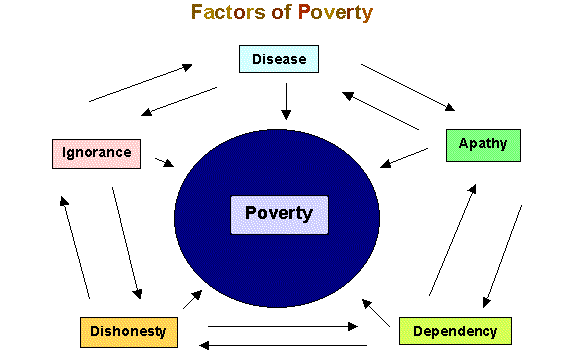
Let us look briefly at each of the big five in turn.
Ignorance:
Ignorance means having a lack of information, or lack of knowledge.
It is different from stupidity which is lack of intelligence, and
different from foolishness which is lack of wisdom. The three are often
mixed up and assumed to be the same by some people.
"Knowledge is power," goes the old saying. Unfortunately, some
people, knowing this, try to keep knowledge to themselves (as a strategy
of obtaining an unfair advantage), and hinder others from obtaining
knowledge. Do not expect that if you train someone in a particular
skill, or provide some information, that the information or skill will
naturally trickle or leak into the rest of a community.
It is important to determine what the information is that is
missing. Many planners and good minded persons who want to help a
community become stronger, think that the solution is education. But
education means many things. Some information is not important to the
situation. It will not help a farmer to know that Romeo and Juliet both
died in Shakespeare's play, but it would be more useful to know which
kind of seed would survive in the local soil, and which would not.
The training in this series of community empowerment documents
includes (among other things) the transfer of information. Unlike a
general education, which has its own history of causes for the selection
of what is included, the information included here is aimed at
strengthening capacity, not for general enlightenment.
Disease:
When a community has a high disease rate, absenteeism is high,
productivity is low, and less wealth is created. Apart from the misery,
discomfort and death that results from disease, it is also a major
factor in poverty in a community. Being well (well-being) not only
helps the individuals who are healthy, it contributes to the eradication
of poverty in the community.
Here, as elsewhere, prevention is better than cure. It is one of
the basic tenets of PHC (primary health care). The economy is much
healthier if the population is always healthy; more so than if people
get sick and have to be treated. Health contributes to the eradication
of poverty more in terms of access to safe and clean drinking water,
separation of sanitation from the water supply, knowledge of hygiene and
disease prevention ─ much more than clinics, doctors and drugs, which
are costly curative solutions rather than prevention against disease.
Remember,
we are concerned with factors, not causes. It does not matter if
tuberculosis was introduced by foreigners who first came to trade, or if
it were autochthonic.& ;
It does not matter if HIV that carries AIDS was
a CIA plot to develop a biological warfare weapon, or if it came from green
monkeys in the soup. Those are possible causes. Knowing the causes
will not remove disease. Knowing the factors can lead to better hygiene
and preventive behaviour, for their ultimate eradication.
Many people see access to health care as a question of human
rights, the reduction of pain and misery and the quality of life of the
people. These are all valid reasons to contribute to a healthy
population. What is argued here, further than those reasons, is that a
healthy population contributes to the eradication of poverty, and it is
also argued that poverty is not only measured by high rates of morbidity
and mortality, but also that disease contributes to other forms and
aspects of poverty.
Apathy:
Apathy is when people do not care, or when they feel so powerless
that they do not try to change things, to right a wrong, to fix a
mistake, or to improve conditions.
Sometimes, some people feel so unable to achieve something, they
are jealous of their family relatives or fellow members of their
community who attempt to do so. Then they seek to bring the attempting
achiever down to their own level of poverty. Apathy breeds apathy.
Sometimes apathy is justified by religious precepts, "Accept what
exists because God has decided your fate." That fatalism may be misused
as an excuse . It is OK to believe God decides our fate, if we accept
that God may decide that we should be motivated to improve ourselves.
"Pray to God, but also row to shore," a Russian proverb, demonstrates
that we are in God's hands, but we also have a responsibility to help
ourselves.
We were created with many abilities: to choose, to cooperate, to
organize in improving the quality of our lives; we should not let God or
Allah be used as an excuse to do nothing. That is as bad as a curse
upon God. We must praise God and use our God-given talents.
In the fight against poverty, the mobilizer uses encouragement and
praise, so that people (1) will want to and (2) learn how to ─ take
charge of their own lives.
Dishonesty:
When resources that are intended to be used for community services
or facilities, are diverted into the private pockets of someone in a
position of power, there is more than morality at stake here. In this
training series, we are not making a value judgement that it is good or
bad. We are pointing out, however, that it is a major cause of poverty.
Dishonesty among persons of trust and power. The amount stolen from
the public, that is received and enjoyed by the individual, is far less
than the decrease in wealth that was intended for the public.
The amount of money that is extorted or embezzled is not the amount
of lowering of wealth to the community. Economists tell of the
"multiplier effect." Where new wealth is invested, the positive effect
on the economy is more than the amount created. When investment money
is taken out of circulation, the amount of wealth by which the community
is deprived is greater than the amount gained by the embezzler. When a
Government official takes a 100 dollar bribe, social investment is
decreased by as much as a 400 dollar decrease in the wealth of the
society.
It is ironic that we get very upset when a petty thief steals ten
dollars' worth of something in the market, yet an official may steal a
thousand dollars from the public purse, which does four thousand dollars
worth of damage to the society as a whole, yet we do not punish the
second thief. We respect the second thief for her or his apparent
wealth, and praise that person for helping all her or his relatives and
neighbours. In contrast, we need the police to protect the first thief
from being beaten by people on the street.
The second thief is a major cause of poverty, while the first thief
may very well be a victim of poverty that is caused by the second. Our
attitude, as described in the paragraph to the left, is more than
ironic; it is a factor that perpetuates poverty. If we reward the one
who causes the major damage, and punish only the ones who are really
victims, then our misplaced attitudes also contribute to poverty. When
embezzled money is then taken out of the country and put in a foreign
(eg Swiss) bank, then it does not contribute anything to the national
economy; it only helps the country of the offshore or foreign bank.
Dependency:
Dependency results from being on the receiving end of charity. In
the short run, as after a disaster, that charity may be essential for
survival. In the long run, that charity can contribute to the possible
demise of the recipient, and certainly to ongoing poverty.
It is an attitude, a belief, that one is so poor, so helpless, that
one can not help one's self, that a group cannot help itself, and that
it must depend on assistance from outside. The attitude, and shared
belief is the biggest self justifying factor in perpetuating the
condition where the self or group must depend on outside help.
There
are several other documents on this web site which refer to dependency.
See: Dependency, and Revealing
Hidden Resources. When showing how to use the telling of stories to
communicate essential principles of development, the story of Mohammed
and the Rope is used as a key illustration of the principle that assistance
should not be the kind of charity that weakens by encouraging dependency,
it should empower.
The community empowerment methodology is an alternative to giving
charity (which weakens), but provides assistance, capital and training
aimed at low income communities identifying their own resources and
taking control of their own development –becoming empowered. All too
often, when a project is aimed at promoting self reliance, the
recipients, until their awareness is raised, expect, assume and hope
that the project is coming just to provide resources for installing a
facility or service in the community.
Among the five major factors of poverty, the dependency syndrome is the one closest to the concerns of the community mobilizer.
Conclusion:
These five factors are not independent of one another. Disease
contributes to ignorance and apathy. Dishonesty contributes to disease
and dependency. And so on. They each contribute to each other.
In any social change process, we are encouraged to "think globally,
act locally." The Big Five factors of poverty appear to be widespread
and deeply embedded in cultural values and practices. We may mistakenly
believe that any of us, at our small level of life, can do nothing about
them.
Do not despair. If each of us make a personal commitment to fight
the factors of poverty at whatever station in life we occupy, then the
sum total of all of us doing it, and the multiplier effect of our
actions on others, will contribute to the decay of those factors, and
the ultimate victory over poverty.
The training material on this web site, is aimed at poverty
reduction on two fronts, (1) reduction of communal poverty by mobilizing
community groups to unite, organize and take community action, and (2)
reduction of personal poverty by the creation of wealth through the
development of micro enterprise.
You, as a mobilizer, are in a key position to have an effect on the
big five of poverty factors. By conducting your mobilizing and
training for poverty reduction, you can ensure your own integrity,
hinder those who would corrupt the system, and encourage all your
participants to practice the attack on factors of poverty in the course
of the actions they choose, when guided and trained by you.
The big five factors of poverty (as
a social problem) include: ignorance,
disease,
apathy,
dishonesty
and dependency.
These, in turn, contribute to secondary factors such as lack of
markets, poor infrastructure, poor leadership, bad governance,
under-employment, lack of skills, lack of capital, and others.
The solution to the social problem of poverty is the social solution of removing the factors of poverty.

No comments:
Post a Comment